
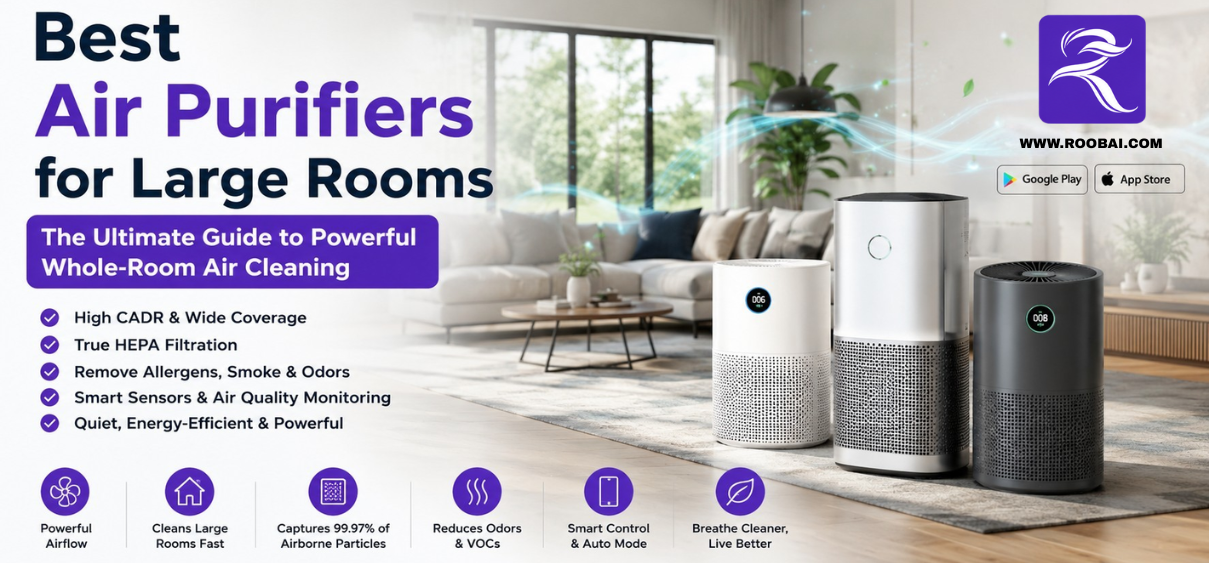
Indoor air quality has become one of the most important health concerns in modern homes, especially in large living spaces where dust, allergens, smoke, pet dander, bacteria, odors, and microscopic pollutants continuously circulate through the air. Whether we live in spacious apartments, open-concept homes, villas, offices, or large family living rooms, maintaining clean indoor air requires a purification system capable of handling higher airflow volumes and wider coverage areas. Fortunately, the best air purifiers for large rooms now combine powerful filtration technologies, intelligent air monitoring systems, quiet operation, and energy-efficient performance to deliver exceptional indoor air purification for expansive spaces.
Modern large-room air purifiers are significantly more advanced than older filtration systems. Today’s leading models feature True HEPA filters, activated carbon filtration, high CADR ratings, multi-stage purification systems, smart sensors, Wi-Fi connectivity, real-time AQI monitoring, and even AI-powered automatic purification modes. These technologies help remove harmful pollutants while continuously adapting to changing indoor air conditions.
This comprehensive guide explores everything we need to know about choosing the best air purifiers for large rooms, including filtration technologies, room coverage, CADR ratings, allergen removal, smoke purification, smart features, maintenance, energy efficiency, and the top-performing models available today.
Why Large Rooms Need Specialized Air Purifiers
Large spaces contain more air volume, which means pollutants spread farther and remain suspended longer. Standard compact air purifiers often struggle to circulate enough clean air throughout expansive areas.
Common large-room pollution sources include:
- Dust accumulation
- Pet dander
- Cooking fumes
- Smoke particles
- Outdoor pollution infiltration
- Pollen
- Mold spores
- VOC gases
- Airborne bacteria
- Allergens
Large rooms require air purifiers with:
- Strong airflow
- High CADR ratings
- Powerful filtration systems
- Large fan systems
- Wide-area circulation
Without sufficient airflow capacity, purification becomes uneven and inefficient.
How Air Purifiers for Large Rooms Work
Large-room air purifiers operate similarly to smaller units but with significantly more powerful airflow systems and advanced filtration capabilities.
The purification process generally includes:
- Drawing polluted air into the purifier
- Capturing large particles using pre-filters
- Trapping microscopic pollutants with HEPA filters
- Removing odors and gases using activated carbon
- Circulating purified air across large spaces
Premium models continuously monitor indoor air quality and automatically adjust purification intensity.
What Makes an Air Purifier Suitable for Large Rooms?
Several important specifications determine whether an air purifier can effectively clean large indoor environments.
Key performance factors include:
- CADR rating
- Room coverage area
- Fan power
- Filter size
- Air circulation efficiency
- Smart sensors
- Noise control
Large-room purification requires balancing power, efficiency, and quiet operation.
Understanding CADR Ratings
CADR stands for Clean Air Delivery Rate.
CADR measures how quickly an air purifier can remove:
- Dust
- Smoke
- Pollen
| CADR Rating | Recommended Usage |
|---|---|
| Below 200 | Small rooms |
| 200–350 | Medium rooms |
| 350–500 | Large rooms |
| 500+ | Very large spaces |
Large-room air purifiers require higher CADR ratings to circulate clean air effectively across wider areas.
Why HEPA Filters Are Essential
HEPA stands for High-Efficiency Particulate Air.
True HEPA filters capture:
- PM2.5 particles
- Dust
- Pollen
- Pet dander
- Mold spores
- Allergens
- Fine smoke particles
Large rooms often accumulate higher airborne particle concentrations, making HEPA filtration critical.
Activated Carbon Filters for Odor and Gas Removal
Activated carbon filters absorb:
- Smoke odors
- Cooking smells
- VOC gases
- Chemical fumes
- Pet odors
- Household odors
In larger rooms, odors spread more widely, making strong carbon filtration highly important.
Key Features to Consider Before Buying a Large-Room Air Purifier
Choosing the ideal purifier requires evaluating several important features.
Room Coverage Area
Coverage area is one of the most important specifications.
| Coverage Area | Best Usage |
|---|---|
| Up to 300 sq ft | Bedrooms |
| 300–600 sq ft | Medium living rooms |
| 600–1000 sq ft | Large rooms |
| 1000+ sq ft | Open-concept homes |
Large-room air purifiers should match or exceed actual room dimensions.
Air Changes Per Hour (ACH)
ACH measures how many times the purifier cleans the room’s air every hour.
| ACH Rating | Air Cleaning Frequency |
|---|---|
| 2 ACH | Basic cleaning |
| 4 ACH | Recommended |
| 5+ ACH | Excellent purification |
Higher ACH improves pollutant removal consistency.
Noise Levels
Large purifiers use powerful fans, but premium models maintain quiet performance.
| Noise Level | Experience |
|---|---|
| Below 25 dB | Nearly silent |
| 25–40 dB | Comfortable |
| 40–55 dB | Noticeable airflow |
Sleep modes help reduce nighttime noise.
Energy Efficiency
Large-room air purifiers often run continuously.
Energy-efficient systems:
- Reduce electricity costs
- Support 24/7 operation
- Improve long-term affordability
- Generate less heat
Modern DC motors greatly improve efficiency.
Smart Features in Modern Large-Room Air Purifiers
Today’s premium air purifiers include advanced intelligent technologies.
Popular smart features include:
- Real-time AQI monitoring
- PM2.5 sensors
- Auto mode
- Wi-Fi connectivity
- Smartphone apps
- Voice assistant support
- Filter replacement alerts
- Child locks
Smart systems automatically adapt purification levels based on pollution intensity.
Best Air Purifiers for Large Living Rooms
Large living rooms experience continuous airflow movement and multiple pollution sources.
Ideal living-room air purifiers prioritize:
- High airflow
- Wide coverage
- Quiet performance
- Stylish design
- Fast purification
Living rooms benefit greatly from continuous whole-room purification.
Best Air Purifiers for Open-Concept Homes
Open-concept spaces require extremely powerful purification systems because air moves freely between:
- Kitchens
- Dining rooms
- Living areas
- Hallways
Open layouts need:
- High CADR
- Multi-directional airflow
- Strong circulation power
- Larger filters
Best Air Purifiers for Allergies in Large Rooms
Large spaces accumulate:
- Dust
- Pollen
- Pet dander
- Mold spores
Allergy-focused purifiers should include:
- True HEPA filters
- High ACH ratings
- Continuous monitoring
- Efficient allergen removal
Cleaner air significantly improves comfort for allergy sufferers.
Best Air Purifiers for Pet Owners
Pet-friendly homes often contain:
- Fur particles
- Dander
- Odors
- Dust accumulation
Pet-focused air purifiers prioritize:
- Strong carbon filtration
- HEPA filtration
- High airflow
- Odor neutralization
Large rooms with pets require continuous air circulation.
Best Air Purifiers for Smoke in Large Rooms
Smoke spreads rapidly across open spaces.
Smoke-focused large-room purifiers require:
- Heavy activated carbon filters
- Strong HEPA systems
- High CADR performance
- Continuous monitoring
These systems effectively remove smoke particles and odors.
Best Air Purifiers for Offices and Commercial Spaces
Large office environments benefit from:
- Quiet operation
- Wide-area purification
- Energy efficiency
- Smart automation
- Professional aesthetics
Cleaner office air improves comfort and workplace productivity.
Top Technologies Used in Large-Room Air Purifiers
| Technology | Function |
|---|---|
| True HEPA Filtration | Fine particle removal |
| Activated Carbon | Odor and gas absorption |
| UV-C Sterilization | Bacteria reduction |
| Ionizers | Particle charging |
| Smart Sensors | Pollution detection |
| AI Automation | Intelligent purification |
Multi-stage purification delivers the best overall air quality improvement.
Best Placement for Large-Room Air Purifiers
Correct placement dramatically improves performance.
Placement recommendations:
- Position centrally
- Avoid blocked airflow
- Keep away from walls
- Avoid tight corners
- Ensure unrestricted circulation
Proper positioning maximizes clean-air distribution.
How Often Should Filters Be Replaced?
Large-room air purifiers process more air, which can affect filter lifespan.
| Filter Type | Replacement Frequency |
|---|---|
| Pre-Filter | Clean monthly |
| HEPA Filter | Every 6–12 months |
| Carbon Filter | Every 6–12 months |
Heavy pollution environments may require more frequent replacement.
Benefits of Large-Room Air Purifiers
Major advantages include:
- Cleaner indoor air
- Better respiratory comfort
- Reduced allergens
- Smoke removal
- Odor reduction
- Improved sleep quality
- Lower dust accumulation
- Fresher indoor environments
Large-room purification supports healthier homes overall.
Common Mistakes When Buying Large-Room Air Purifiers
Consumers frequently make several purchasing mistakes.
Buying undersized units
Small purifiers cannot handle large spaces effectively.
Ignoring CADR ratings
High airflow is essential for larger rooms.
Overlooking filter replacement costs
Long-term maintenance matters.
Choosing weak carbon filtration
Thin carbon filters struggle with odors.
Large-Room Air Purifiers vs Small Air Purifiers
| Feature | Large-Room Purifier | Small Purifier |
|---|---|---|
| Coverage | Wide-area | Limited |
| Airflow | Powerful | Moderate |
| CADR | High | Lower |
| Filter Size | Large | Compact |
| Purification Speed | Faster | Slower |
Large-room models are specifically engineered for high-volume purification.
Top Recommended Air Purifiers for Large Rooms
| Air Purifier | Best For | Key Features |
|---|---|---|
| Coway Airmega 400 | Open homes | Massive room coverage |
| Blueair Blue Pure 211+ | Smoke and allergens | High CADR performance |
| Dyson Purifier Big+Quiet | Premium homes | Intelligent airflow |
| Honeywell Air Touch i9 | Large living rooms | Strong filtration |
| Philips AC3059/65 | Smart purification | Real-time AQI monitoring |
| Levoit Core 600S | Large bedrooms | Smart HEPA system |
Air Purifiers vs HVAC Systems
Many homeowners compare standalone purifiers with HVAC filtration systems.
| Feature | Air Purifier | HVAC Filter |
|---|---|---|
| HEPA Filtration | Yes | Limited |
| Odor Removal | Yes | Minimal |
| Smart Monitoring | Yes | Rare |
| Portable Usage | Yes | No |
Standalone purifiers provide more targeted purification performance.
How Air Purifiers Improve Indoor Comfort
Cleaner air creates:
- Easier breathing
- Fresher indoor environments
- Better sleep
- Reduced odors
- Lower allergen exposure
- Improved relaxation
Large-room purification improves overall living quality significantly.
Future of Large-Room Air Purification Technology
Future innovations may include:
- AI-powered purification
- Smarter pollution prediction
- Self-cleaning filters
- Improved energy optimization
- Enhanced VOC neutralization
- Better smart home integration
Air purification technology continues advancing rapidly.
How to Choose the Best Air Purifier for Large Rooms
The ideal purifier depends on:
- Room dimensions
- Pollution levels
- Allergies
- Pets
- Smoke exposure
- Smart feature preferences
- Budget
Balancing these factors ensures better long-term satisfaction.
Are Large-Room Air Purifiers Worth Buying?
Modern large-room air purifiers provide exceptional value.
They help:
- Clean expansive indoor spaces
- Improve respiratory comfort
- Remove allergens
- Reduce odors
- Improve sleep quality
- Create healthier homes
For larger households, they are among the most beneficial indoor appliances available today.
Conclusion
The best air purifiers for large rooms combine powerful airflow systems, advanced HEPA filtration, intelligent air monitoring, and energy-efficient operation to create cleaner and healthier indoor environments. Whether we need whole-room purification for open living spaces, allergy relief, smoke removal, pet odor control, or improved indoor comfort, modern large-room air purifiers deliver outstanding performance across expansive areas.
Today’s leading models provide fast purification, smart automation, silent operation, and premium filtration technologies that dramatically improve indoor air quality. By focusing on CADR ratings, room coverage, HEPA filtration, activated carbon performance, and smart features, consumers can choose the ideal purifier for healthier large-space living.
Clean indoor air is essential for long-term comfort and wellness, especially in larger environments where pollutants continuously circulate. Investing in a high-quality large-room air purifier is one of the smartest upgrades for modern homes.
FAQs
1. What is the best air purifier for large rooms?
The best model depends on coverage area, CADR, and filtration quality.
2. What CADR is ideal for large rooms?
A CADR above 350 is recommended for larger spaces.
3. Do large-room air purifiers consume more electricity?
Modern models are highly energy efficient.
4. Are HEPA filters necessary?
Yes, HEPA filtration is essential for fine particle removal.
5. Can air purifiers remove smoke?
Yes, especially models with activated carbon filters.
6. How large of a room can an air purifier clean?
Some premium models support over 1000 square feet.
7. Are smart air purifiers worth it?
Yes, smart automation improves convenience and efficiency.
8. How often should filters be replaced?
Typically every 6–12 months.
9. Can air purifiers reduce allergies?
Yes, they remove airborne allergens effectively.
10. Are air purifiers noisy?
Premium models operate quietly.
11. What is ACH?
ACH refers to air changes per hour.
12. Can air purifiers remove pet odors?
Activated carbon helps eliminate odors.
13. Are large-room purifiers suitable for bedrooms?
Yes, especially quiet models with sleep modes.
14. Do air purifiers help asthma sufferers?
Cleaner air can improve respiratory comfort.
15. Can air purifiers eliminate dust?
They reduce airborne dust significantly.
16. Do air purifiers cool rooms?
No, they clean air but do not lower temperatures.
17. Which brand is best for large-room purification?
Coway, Blueair, Philips, Dyson, and Honeywell are highly trusted.
18. Are UV-C filters useful?
They help reduce airborne bacteria.
19. Can air purifiers improve sleep quality?
Cleaner air often improves breathing comfort during sleep.
20. Are large-room air purifiers expensive to maintain?
Filter replacement costs vary by model.
21. Can air purifiers remove cooking smells?
Yes, activated carbon filters help absorb odors.
22. Do air purifiers need continuous operation?
Continuous usage delivers the best results.
23. Can air purifiers remove VOC gases?
Activated carbon helps absorb VOC pollutants.
24. Are air purifiers worth buying for open homes?
Absolutely.
25. Do large-room air purifiers improve indoor air quality significantly?
Yes, they dramatically improve overall air cleanliness.