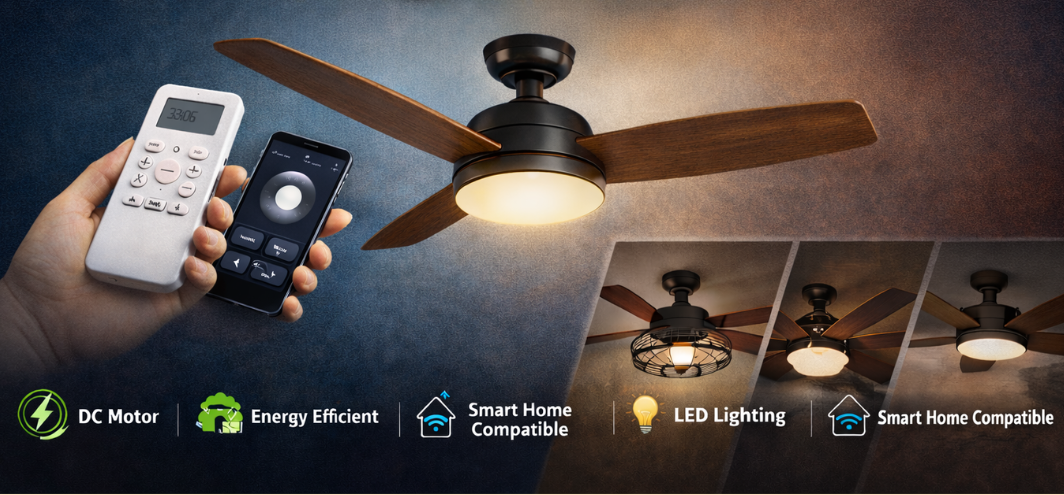
Ceiling fans with remote control have transformed the way modern homes manage comfort, airflow, and energy efficiency. Instead of manually pulling chains or adjusting wall switches, we can control fan speed, lighting, direction, and timers from anywhere in the room. This convenience, combined with improved design and smart technology, has made remote-controlled ceiling fans one of the most sought-after home appliances.
In this comprehensive guide, we explore everything needed to choose the best ceiling fans with remote, including features, performance factors, installation considerations, and top buying tips. This guide provides detailed insights to help homeowners select the perfect ceiling fan that delivers comfort, efficiency, and style.
Why Ceiling Fans With Remote Control Are Essential for Modern Homes
Remote-controlled ceiling fans provide a level of comfort and functionality that traditional fans cannot match.
Convenience and Accessibility
Remote operation eliminates the need to reach pull chains or wall switches. With a handheld remote, we can:
-
Adjust fan speed instantly
-
Turn lights on or off
-
Change fan direction
-
Set timers or sleep modes
This is especially useful in large rooms, high ceilings, and bedrooms where accessibility matters.
Improved Energy Efficiency
Remote-controlled fans often include energy-saving features, such as programmable timers and variable speed motors. By optimizing airflow, these fans help reduce reliance on air conditioning, leading to lower electricity bills.
Enhanced Comfort Control
The ability to adjust airflow without leaving the couch or bed improves comfort significantly. Modern remotes allow precise speed control, ensuring the ideal airflow level for every situation.
Key Features to Look for in the Best Ceiling Fans With Remote
Choosing the best ceiling fan requires understanding the most important features that impact performance and convenience.
1. Motor Technology
The motor is the heart of a ceiling fan. Two main types dominate the market:
AC Motors
-
Traditional technology
-
Lower upfront cost
-
Reliable performance
DC Motors
-
Up to 70% more energy efficient
-
Extremely quiet operation
-
More speed settings
-
Longer lifespan
For modern homes, DC motor ceiling fans are widely considered the best option.
2. Remote Control Functions
A quality ceiling fan remote should provide several essential functions:
-
Multiple speed control
-
Light dimming
-
Fan direction reversal
-
Sleep timer
-
Fan mode presets
Advanced models may also include LCD displays or touch controls.
3. Blade Design and Size
Blade size directly affects airflow efficiency.
| Room Size | Recommended Fan Size |
|---|---|
| Up to 75 sq ft | 29–36 inches |
| 76–144 sq ft | 36–42 inches |
| 144–225 sq ft | 44 inches |
| 225–400 sq ft | 52 inches |
| Over 400 sq ft | 60 inches or larger |
The number of blades also impacts airflow. Most premium fans feature 3 to 5 aerodynamically designed blades for maximum efficiency.
4. Lighting Integration
Many ceiling fans include integrated lighting systems. Popular options include:
-
LED light kits
-
Dimmable lighting
-
Color temperature control
-
Smart light compatibility
LED lights are ideal due to their long lifespan and low energy consumption.
5. Smart Home Compatibility
Many modern ceiling fans integrate with smart home ecosystems. Features may include:
-
Voice control
-
Mobile app operation
-
Automation schedules
This allows seamless integration with home automation systems.
Benefits of Using Remote-Controlled Ceiling Fans
Remote-controlled ceiling fans deliver several advantages over traditional models.
1. Superior Comfort Management
With remote access, airflow adjustments become instant and effortless.
2. Improved Safety
High ceilings often make pull chains difficult or dangerous to reach. Remote control eliminates this issue.
3. Quiet Operation
Most modern remote-controlled fans use advanced motor technology that significantly reduces operational noise.
4. Aesthetic Appeal
Premium ceiling fans are designed to enhance interior decor with styles ranging from:
-
Contemporary
-
Industrial
-
Rustic
-
Minimalist
-
Luxury designer models
Top Styles of Ceiling Fans With Remote
Different interior styles require different ceiling fan designs.
Modern Ceiling Fans
Modern fans feature:
-
Minimalist blade designs
-
Matte or metallic finishes
-
Integrated LED lighting
Perfect for contemporary homes and apartments.
Industrial Ceiling Fans
Industrial models are known for:
-
Large blades
-
Powerful motors
-
High airflow capacity
These are ideal for lofts, warehouses, and large living rooms.
Luxury Designer Ceiling Fans
Premium ceiling fans often include:
-
Unique blade shapes
-
Handcrafted materials
-
Decorative finishes
They combine functionality with interior design elegance.
How to Choose the Best Ceiling Fan With Remote
Selecting the perfect ceiling fan requires evaluating several factors.
Room Size and Ceiling Height
Fan size must match room dimensions. Larger rooms require bigger blades and stronger motors.
Ceiling height also affects installation type:
-
Flush mount for low ceilings
-
Downrod mount for high ceilings
-
Angled mount for sloped ceilings
Airflow Efficiency (CFM Rating)
CFM stands for Cubic Feet per Minute, which measures airflow performance.
| Fan Size | Ideal CFM |
|---|---|
| Small fans | 2000–3000 CFM |
| Medium fans | 3000–4500 CFM |
| Large fans | 4500–7000+ CFM |
Higher CFM ensures better cooling performance.
Energy Efficiency Ratings
Energy-efficient fans reduce electricity consumption. Look for:
-
Energy Star certification
-
DC motors
-
LED lighting
These features ensure long-term savings.
Installation Tips for Ceiling Fans With Remote
Proper installation ensures optimal performance and safety.
Secure Mounting
The fan must be mounted to a ceiling fan-rated electrical box to support weight and vibration.
Correct Downrod Length
Downrod length determines optimal airflow. Recommended distance:
-
8–9 feet above floor for best circulation.
Remote Receiver Placement
The receiver unit must be installed inside the canopy and properly connected to the motor wiring.
Maintenance Tips for Long-Lasting Ceiling Fans
Maintaining a ceiling fan ensures smooth operation and long life.
Regular Cleaning
Dust accumulation reduces airflow. Clean blades every 4–6 weeks.
Check Blade Alignment
Unbalanced blades cause wobbling. Ensure all blades remain properly aligned.
Lubricate Moving Parts
Some fans require periodic lubrication to maintain smooth motor function.
Common Problems With Remote Ceiling Fans and Solutions
Remote Not Working
Possible causes include:
-
Dead batteries
-
Signal interference
-
Receiver malfunction
Fan Wobbling
Common reasons:
-
Loose screws
-
Unbalanced blades
-
Improper mounting
Fan Not Responding
This may indicate:
-
Wiring issues
-
Faulty receiver
-
Motor failure
Advantages of DC Motor Ceiling Fans With Remote
DC motor fans are becoming the industry standard due to their numerous benefits.
Energy Efficiency
They use significantly less power than AC motors.
Quiet Operation
DC motors produce minimal noise, making them ideal for bedrooms.
More Speed Settings
Many DC fans offer up to 6 speed levels, allowing precise airflow control.
Ceiling Fan Placement Tips for Maximum Cooling
Correct placement improves airflow efficiency.
-
Install fans in the center of the room
-
Maintain 18–24 inches clearance from walls
-
Use multiple fans for large rooms
These adjustments improve airflow distribution significantly.
Best Rooms to Install Remote-Controlled Ceiling Fans
Remote-controlled ceiling fans work best in several areas.
Bedrooms
Remote operation allows speed adjustment without getting out of bed.
Living Rooms
Provides airflow control for large seating areas.
Dining Areas
Improves air circulation while maintaining comfort.
Outdoor Covered Patios
Weather-resistant models are perfect for outdoor relaxation.
Ceiling Fans vs Air Conditioners
Ceiling fans complement air conditioning systems rather than replace them.
| Feature | Ceiling Fans | Air Conditioners |
|---|---|---|
| Energy Use | Low | High |
| Cooling Method | Air circulation | Temperature reduction |
| Installation Cost | Low | High |
| Maintenance | Minimal | Moderate |
Using both together improves energy efficiency and comfort.
Future Trends in Remote-Controlled Ceiling Fans
Ceiling fan technology continues to evolve.
Smart Voice Integration
Fans are increasingly compatible with voice assistants.
App-Controlled Operation
Mobile apps allow control from anywhere in the home.
Smart Sensors
Some fans automatically adjust speed based on room temperature or occupancy.
Conclusion
Ceiling fans with remote control represent the perfect blend of comfort, efficiency, and modern convenience. With advanced motor technology, smart features, and stylish designs, these fans enhance indoor comfort while reducing energy consumption.
Choosing the right model requires careful consideration of motor type, blade size, airflow rating, and smart features. By selecting a high-quality remote-controlled ceiling fan, homeowners can enjoy quiet operation, effortless control, and year-round comfort.
FAQs
1. What is a remote-controlled ceiling fan?
A ceiling fan that can be operated using a wireless handheld remote.
2. Are remote ceiling fans energy efficient?
Yes, especially models with DC motors and LED lighting.
3. Can I add a remote to an existing ceiling fan?
Yes, universal remote kits are available.
4. Do ceiling fan remotes require batteries?
Most remotes use AAA or coin cell batteries.
5. What is the best fan size for a bedroom?
Usually 42–52 inches depending on room size.
6. Are remote ceiling fans noisy?
High-quality fans operate very quietly.
7. What is CFM in ceiling fans?
CFM measures airflow performance.
8. Can a ceiling fan cool a room?
Fans circulate air to create a cooling effect.
9. Do remote fans work during power outages?
No, they require electricity.
10. How long do ceiling fans last?
Quality fans last 10–15 years or more.
11. Are smart ceiling fans worth it?
Yes, they offer automation and voice control.
12. Can one remote control multiple fans?
Some systems allow multiple fan control.
13. Do ceiling fans reduce AC usage?
Yes, they improve air circulation.
14. What is the ideal ceiling fan height?
About 8–9 feet from the floor.
15. Are LED ceiling fan lights replaceable?
Yes, many models allow LED replacement.
16. What is the difference between AC and DC fan motors?
DC motors are quieter and more efficient.
17. Do remote ceiling fans require special wiring?
No, standard wiring usually works.
18. Can ceiling fans be installed outdoors?
Yes, with weather-rated models.
19. How many blades are best?
Most fans perform best with 3–5 blades.
20. What causes ceiling fan wobble?
Loose screws or blade imbalance.
21. Are large fans better for cooling?
Large fans move more air efficiently.
22. Can ceiling fans help in winter?
Yes, reversing direction circulates warm air downward.
23. What is a flush mount ceiling fan?
A fan mounted close to the ceiling.
24. How often should fans be cleaned?
At least once a month.
25. Are remote ceiling fans safe?
Yes, when installed correctly.
For more information and to start using Roobai.com, visit our official website and download the app to stay updated on the best deals and offers. With Roobai.com, you can ensure that every shopping experience is not just an opportunity to shop but an opportunity to save big.