
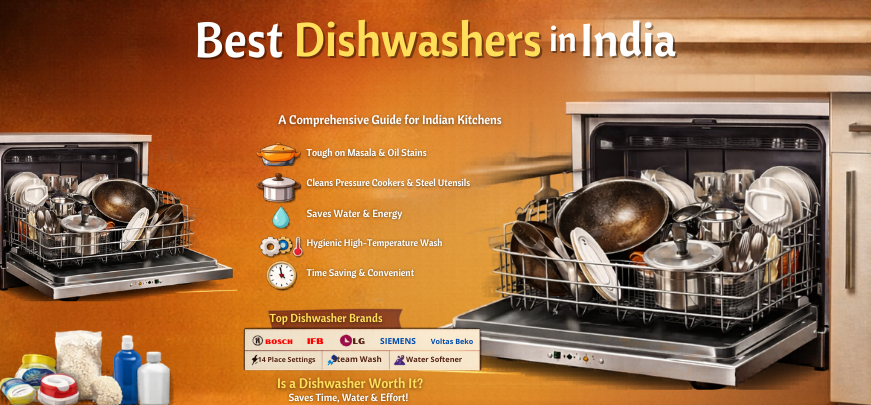
In today’s fast-paced households, we increasingly seek appliances that save time, conserve resources, and elevate hygiene standards. Among these, the dishwasher has emerged as a transformative addition to Indian kitchens. Once considered a luxury, dishwashers are now recognized as essential appliances for families who value convenience, cleanliness, and efficiency.
We present this in-depth guide to help households choose the best dishwasher in India, understand features that truly matter, and make an informed purchase decision suited to Indian cooking habits, utensils, and water conditions.
Why Dishwashers Are Becoming Essential in Indian Homes
Indian cooking involves oil-heavy curries, masalas, burnt residues, pressure cooker stains, kadais, tawas, and steel utensils. Manual washing consumes enormous time, water, and effort. Modern dishwashers are engineered to handle:
- Sticky masala stains
- Oily cookware
- Burnt pressure cooker bottoms
- Large stainless steel utensils
- Delicate glassware
- Heavy kadais and pans
We find that a dishwasher uses less water than manual washing, ensures higher hygiene through high-temperature washing, and eliminates the daily chore that consumes hours each week.
Types of Dishwashers Available in India
1. Free-Standing Dishwashers
These are the most popular models. They can be placed anywhere with a water inlet and drain.
2. Built-In Dishwashers
Integrated into modular kitchens, offering a seamless aesthetic.
3. Countertop Dishwashers
Compact units for small families or apartments with limited space.
Key Features to Consider Before Buying a Dishwasher
Capacity (Place Settings)
A place setting includes plates, bowls, glasses, and cutlery.
| Family Size | Recommended Capacity |
|---|---|
| 1–2 members | 6–8 place settings |
| 3–4 members | 12 place settings |
| 5+ members | 14–15 place settings |
Wash Programs
Look for programs like:
- Intensive wash (for kadais, cookers)
- Eco wash (water saving)
- Quick wash
- Glass care
- Pre-rinse
- Half-load
Water and Energy Efficiency
Modern dishwashers consume 9–12 liters per cycle, far less than hand washing.
Heating Technology
Hot water (60–70°C) dissolves grease and ensures hygiene.
Noise Level
Below 50 dB is considered quiet.
Racks and Flexibility
Adjustable racks help accommodate large utensils.
Hard Water Compatibility
Indian homes often have hard water; ensure the machine has a water softener.
Best Dishwashers in India (Top Picks)
1. Bosch 14 Place Settings Dishwasher
- Intensive wash for Indian utensils
- EcoSilence Drive
- VarioSpeed for faster washing
- In-built water softener
2. IFB Neptune VX Fully Electronic Dishwasher
- Steam drying
- 12 place settings
- Hard water compatibility
- Delay start option
3. LG 14 Place Settings Dishwasher with TrueSteam
- Steam wash for hygiene
- Flexible racks
- Inverter Direct Drive motor
4. Siemens 14 Place Settings Dishwasher
- Zeolith drying technology
- IntensiveZone for tough stains
- Quiet operation
5. Voltas Beko 14 Place Settings Dishwasher
- Affordable and powerful
- Hygiene wash
- 8 wash programs
How Dishwashers Handle Indian Utensils
We observe that modern dishwashers effectively clean:
- Pressure cookers
- Kadhai and pans
- Steel plates and bowls
- Tiffin boxes
- Glassware
- Ceramic cookware
Items to avoid:
- Wooden utensils
- Non-dishwasher-safe plastics
- Iron tawa
- Aluminium vessels (unless specified safe)
Detergents, Salt, and Rinse Aid: What You Need
A dishwasher requires:
- Dishwasher detergent (powder/tablet)
- Dishwasher salt (for hard water)
- Rinse aid (for spotless drying)
These ensure optimal performance and longevity.
Installation Requirements
- Water inlet connection
- Drain outlet
- 16A power socket
- Space: 60 cm width for full-size units
Water Consumption vs Hand Washing
| Method | Water Usage |
|---|---|
| Hand washing | 40–60 liters |
| Dishwasher | 9–12 liters |
Electricity Consumption
Most dishwashers consume 1–1.5 units per cycle, making them energy efficient.
Common Myths About Dishwashers in India
Myth: Pre-rinsing is necessary
Fact: Scrape food; no rinsing required
Myth: Dishwashers waste water
Fact: They save up to 70% water
Myth: Indian utensils cannot be washed
Fact: Intensive mode handles heavy grease
How to Load a Dishwasher Properly
- Place plates facing inward
- Keep bowls tilted
- Large utensils at bottom rack
- Glasses on top rack
- Do not overcrowd
Maintenance Tips for Long Life
- Clean filter weekly
- Refill salt monthly
- Use rinse aid regularly
- Run empty cycle with vinegar monthly
Benefits of Using a Dishwasher Daily
- Time saving
- Hygienic washing
- Water saving
- No dependency on domestic help
- Organized kitchen routine
Is a Dishwasher Worth It for Indian Homes?
We conclude that for any household cooking daily meals, a dishwasher is a highly valuable investment that pays back in time, water savings, and convenience.
Comparison Table of Top Dishwashers
| Brand | Capacity | Wash Programs | Noise | Special Feature |
|---|---|---|---|---|
| Bosch | 14 | 6 | 48 dB | Water softener |
| IFB | 12 | 8 | 49 dB | Steam drying |
| LG | 14 | 9 | 44 dB | TrueSteam |
| Siemens | 14 | 7 | 46 dB | Zeolith drying |
| Voltas Beko | 14 | 8 | 49 dB | Hygiene wash |
Cost of Dishwashers in India
Price range: ₹25,000 to ₹65,000 depending on brand and features.
Who Should Buy a Dishwasher
- Working professionals
- Families with daily cooking
- Homes with hard water
- Households seeking hygiene
- People wanting to save time
25 FAQs About Dishwashers in India
- Do dishwashers clean oily Indian utensils?
Yes, intensive wash handles grease. - Is pre-rinsing required?
No. - Can pressure cookers be washed?
Yes. - How much water is used?
9–12 liters. - Does it remove masala stains?
Yes. - What detergent is needed?
Dishwasher-specific detergent. - Can glassware be washed?
Yes. - Is installation complex?
No. - Is it noisy?
No, under 50 dB. - Does it increase electricity bill?
Minimal impact. - Can non-stick pans be washed?
If dishwasher safe. - How often to refill salt?
Monthly. - Can steel utensils be washed?
Yes. - What cannot be washed?
Wood, iron, aluminum (some). - Is it suitable for small kitchens?
Yes, countertop models available. - How long does a cycle take?
45–120 minutes. - Is drying effective?
Yes. - Can it run half load?
Yes. - Is maintenance high?
No. - Does it remove burnt stains?
Yes. - Is hard water a problem?
No, with salt. - Can it replace a maid?
Yes for dishwashing. - Does it smell?
No, with maintenance. - Is it safe for children’s bottles?
Yes. - Is it worth the investment?
Absolutely.