
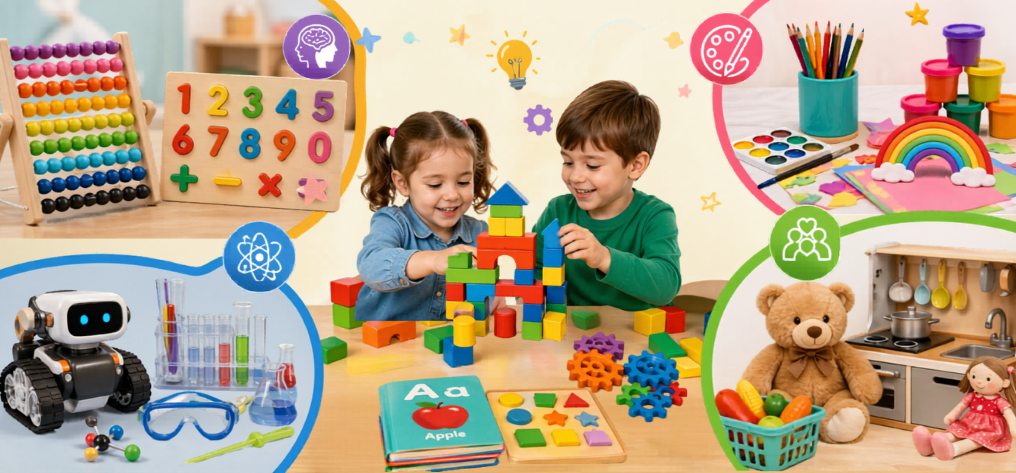
Best Educational Toys for Kids
Selecting the best educational toys for kids is a decisive step toward shaping intellectual ability, creativity, and lifelong learning habits. We focus on delivering a high-performance, research-driven selection approach that ensures every toy contributes meaningfully to a child’s cognitive, emotional, social, and physical development. This comprehensive guide presents an authoritative breakdown of the most effective educational toys, categorized by age, skill development, and learning outcomes.
Why Educational Toys Are Essential for Child Development
Educational toys are not merely playthings; they are powerful developmental tools that build foundational skills in early childhood. The right toys enhance:
- Cognitive intelligence through structured problem-solving
- Fine and gross motor skills via interactive engagement
- Language and communication abilities
- Creativity and imagination
- Emotional intelligence and social awareness
Children exposed to high-quality learning toys consistently demonstrate improved attention spans, curiosity, and adaptive thinking.
Key Features of the Best Educational Toys for Kids
1. Skill-Oriented Design
The most effective toys are designed with a clear developmental purpose, such as:
- Logical reasoning
- Memory enhancement
- Pattern recognition
- Spatial awareness
2. Age-Appropriate Complexity
Educational toys must align with developmental stages:
- Toddlers: Sensory and motor skill toys
- Preschoolers: Basic problem-solving and language tools
- School-age children: STEM, strategy, and analytical toys
3. Interactive and Engaging Elements
Toys that encourage active participation outperform passive toys:
- Hands-on building
- Sound and light responses
- Multi-sensory interaction
4. Safe and Durable Materials
Premium educational toys use:
- Non-toxic materials
- Rounded edges
- Long-lasting construction
Top Categories of Educational Toys for Kids
1. STEM Educational Toys (Science, Technology, Engineering, Math)
STEM toys introduce children to analytical thinking and innovation.
Popular Examples:
- Coding kits
- Robotics sets
- Science experiment kits
Key Benefits:
- Develops critical thinking
- Encourages problem-solving skills
- Builds technical understanding
2. Building and Construction Toys
Construction toys are essential for hands-on learning and creative exploration.
Examples Include:
- Interlocking bricks
- Magnetic tiles
- Engineering kits
Developmental Impact:
- Enhances spatial intelligence
- Strengthens fine motor skills
- Encourages design thinking
3. Language and Literacy Toys
Language-based toys improve communication skills and vocabulary.
Top Choices:
- Alphabet puzzles
- Storytelling kits
- Interactive reading devices
Benefits:
- Boosts reading readiness
- Enhances verbal expression
- Improves listening comprehension
4. Math and Logic Toys
Mathematical toys build a strong foundation in numeracy and logical reasoning.
Examples:
- Number puzzles
- Counting beads
- Logic games
Advantages:
- Strengthens problem-solving skills
- Develops numerical fluency
- Improves analytical thinking
5. Creative and Art-Based Toys
Creative toys unlock a child’s imagination and artistic abilities.
Popular Options:
- Drawing kits
- Craft sets
- Clay modeling kits
Impact:
- Enhances creativity
- Improves hand-eye coordination
- Encourages self-expression
6. Sensory and Motor Skill Toys
These toys stimulate sensory processing and physical coordination.
Examples:
- Textured toys
- Balance boards
- Activity cubes
Benefits:
- Supports brain development
- Enhances focus
- Improves motor coordination
7. Role-Play and Social Development Toys
Role-play toys foster empathy and social interaction.
Examples:
- Kitchen sets
- Doctor kits
- Puppet theaters
Advantages:
- Builds social intelligence
- Encourages teamwork
- Develops communication skills
Best Educational Toys by Age Group
Educational Toys for Toddlers (1–3 Years)
Recommended Toys:
- Stacking rings
- Shape sorters
- Musical toys
Focus Areas:
- Sensory exploration
- Basic motor skills
- Early cognitive development
Educational Toys for Preschoolers (3–5 Years)
Top Picks:
- Alphabet learning boards
- Simple puzzles
- Pretend play kits
Development Goals:
- Language skills
- Imagination
- Problem-solving
Educational Toys for Kids (5–8 Years)
Best Options:
- STEM kits
- Math games
- Science experiments
Key Focus:
- Logical thinking
- Academic readiness
- Creativity
Educational Toys for Older Kids (8+ Years)
Recommended Choices:
- Advanced robotics kits
- Strategy board games
- Coding tools
Skill Development:
- Advanced reasoning
- Strategic planning
- Technical skills
Educational Toys vs Regular Toys: A Comparative Analysis
| Feature | Educational Toys | Regular Toys |
|---|---|---|
| Purpose | Skill development | Entertainment |
| Learning Value | High | Limited |
| Engagement | Interactive | Passive |
| Cognitive Impact | Strong | Minimal |
| Long-Term Benefits | Significant | Short-term |
How to Choose the Best Educational Toys for Kids
We recommend a structured selection process:
- Identify the child’s developmental needs
- Choose toys with multi-functional benefits
- Prefer open-ended toys that allow creativity
- Avoid excessive reliance on screen-based toys
- Rotate toys to maintain engagement and novelty
Benefits of Investing in Educational Toys
- Accelerated cognitive growth
- Improved academic performance
- Enhanced creativity and innovation
- Better emotional and social development
- Reduced dependency on digital devices
Common Mistakes to Avoid When Buying Educational Toys
- Selecting toys that are too complex or too simple
- Ignoring age recommendations
- Choosing toys based solely on trends or branding
- Overloading children with too many options
- Neglecting safety standards
Expert Strategies for Maximizing Learning Through Play
- Engage in guided play sessions
- Encourage independent exploration
- Combine multiple toys for integrated learning
- Set up a structured play environment
- Observe and adapt to the child’s interests and strengths
Future Trends in Educational Toys
The educational toy industry continues to evolve with innovations such as:
- AI-powered learning toys
- Interactive augmented reality tools
- Eco-friendly and sustainable toy materials
- Personalized learning experiences
These advancements are reshaping how children learn and interact with their environment.
FAQs
1. What are educational toys?
Toys designed to promote learning and skill development.
2. At what age should children start using educational toys?
From as early as infancy.
3. Are STEM toys important?
Yes, they build critical thinking and innovation skills.
4. How many educational toys should a child have?
A curated set of 10–20 high-quality toys.
5. Are digital educational toys effective?
Yes, when used in moderation.
6. What toys improve memory?
Puzzle games and matching activities.
7. Are wooden toys better?
Yes, for durability and safety.
8. Can toys improve social skills?
Yes, especially role-play toys.
9. What are open-ended toys?
Toys with multiple ways to play.
10. Should toys be rotated?
Yes, every 2–4 weeks.
11. What toys enhance creativity?
Art and craft kits.
12. Are expensive toys better?
Not always; focus on quality and purpose.
13. What toys improve focus?
Building and logic toys.
14. Are group toys beneficial?
Yes, for teamwork and communication.
15. What toys help with anxiety?
Sensory toys.
16. Are DIY toys effective?
Yes, they boost creativity.
17. What is the best STEM toy?
Robotics kits.
18. Can toys replace learning?
No, they complement education.
19. What toys are best for travel?
Compact educational games.
20. Are puzzles essential?
Yes, for problem-solving skills.
21. What toys reduce screen time?
Hands-on interactive toys.
22. Are musical toys educational?
Yes, they enhance sensory development.
23. What toys improve motor skills?
Stacking and construction toys.
24. Should toys be gender-neutral?
Yes, all toys can be inclusive.
25. What is the best all-in-one educational toy?
Activity centers.