
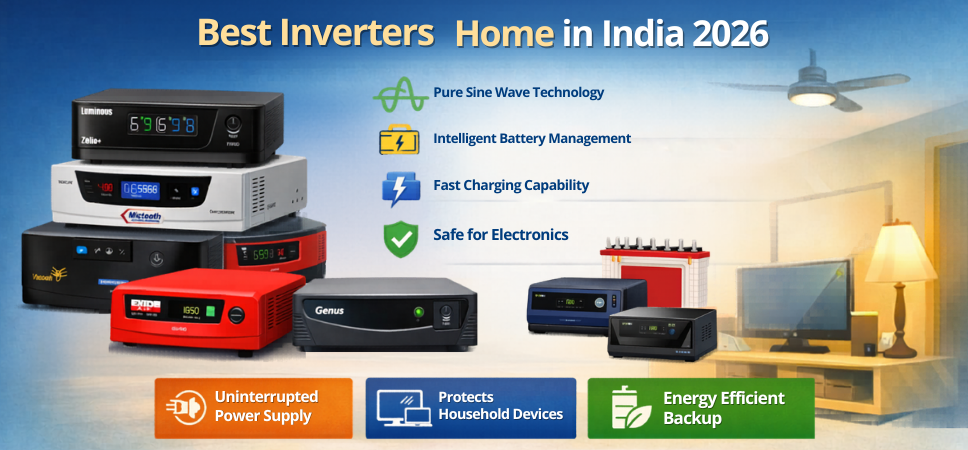
Frequent power cuts in many regions of India make a home inverter system an essential part of modern households. A high-quality inverter ensures uninterrupted electricity for essential appliances such as lights, fans, televisions, routers, and computers. Choosing the best inverter for home in India allows households to maintain comfort, productivity, and safety during power outages.
Modern inverter systems are designed with advanced power management technology, fast charging capability, pure sine wave output, intelligent battery management, and efficient energy usage. These features ensure consistent power delivery while protecting household electronics from voltage fluctuations.
This comprehensive guide explores the best inverters for home use in India, compares top models, highlights key features, and provides detailed insights for selecting the most reliable inverter system.
What Is a Home Inverter
A power inverter is an electrical device that converts DC (direct current) electricity from batteries into AC (alternating current) used by household appliances. When the main power supply fails, the inverter automatically switches to battery power and provides backup electricity.
A typical home inverter system consists of:
-
Inverter unit
-
Battery or battery bank
-
Charging circuit
-
Automatic power switching system
These components work together to ensure seamless power backup during outages.
Why Every Home in India Needs an Inverter
Electricity interruptions can disrupt daily life and damage electronic devices. Installing a reliable home inverter system offers several advantages.
Key Benefits of Home Inverters
-
Continuous power supply during outages
-
Protection for household electronics
-
Stable voltage output
-
Improved convenience and comfort
-
Energy-efficient power backup
An efficient inverter system ensures uninterrupted operation of essential appliances.
Types of Inverters for Home Use in India
Understanding the different inverter technologies helps in choosing the best option for household needs.
Square Wave Inverters
Square wave inverters are the most basic type of inverter technology.
Characteristics
-
Simple design
-
Lower cost
-
Suitable for basic appliances
-
Less efficient compared to advanced models
These inverters may produce slight noise in fans or appliances.
Modified Sine Wave Inverters
Modified sine wave inverters offer improved power output compared to square wave models.
Characteristics
-
More stable voltage output
-
Suitable for household electronics
-
Affordable price range
However, they may not be ideal for sensitive devices.
Pure Sine Wave Inverters
Pure sine wave inverters produce electricity similar to the main power grid.
Characteristics
-
Smooth and stable output
-
Compatible with all appliances
-
Highly efficient
-
Ideal for modern electronics
Pure sine wave models are considered the best inverters for home use in India.
Best Inverter Capacity for Homes
Selecting the correct inverter capacity ensures efficient power backup.
Typical Power Consumption
| Appliance | Approx Power |
|---|---|
| LED Bulb | 10W |
| Ceiling Fan | 70W |
| Television | 120W |
| WiFi Router | 10W |
| Laptop | 60W |
A typical household backup requirement may range from 400W to 800W depending on appliances.
Best Inverters for Home in India (2026)
Below are some of the most reliable inverter systems available in the Indian market.
Luminous Zelio+ 1100 Home Inverter
The Luminous Zelio+ 1100 is one of the most popular home inverter systems in India.
Key Features
-
Pure sine wave technology
-
900VA capacity
-
LCD display with power indicators
-
Intelligent battery management
-
Silent operation
Performance Highlights
This inverter delivers stable power output and efficient charging, making it ideal for small and medium households.
Microtek UPS SEBz 1100 Pure Sine Wave Inverter
The Microtek UPS SEBz 1100 offers powerful backup performance and reliable operation.
Key Features
-
Pure sine wave output
-
900VA capacity
-
Digital display
-
Smart overload protection
-
Advanced battery charging
Performance Highlights
It supports multiple appliances and ensures stable voltage supply.
V-Guard Smart Pro 1200 Inverter
The V-Guard Smart Pro 1200 is designed for efficient home backup power.
Key Features
-
Pure sine wave technology
-
Bluetooth mobile monitoring
-
High charging current
-
Advanced battery compatibility
-
Intelligent safety protections
Performance Highlights
The mobile monitoring feature allows real-time inverter status tracking.
Exide GQP 1050 Pure Sine Wave Inverter
The Exide GQP 1050 provides dependable backup performance.
Key Features
-
Pure sine wave output
-
Compact design
-
Intelligent battery charging
-
Advanced safety protection
Performance Highlights
It is ideal for homes requiring consistent backup for lights, fans, and televisions.
Genus Invomax 1100 Inverter
The Genus Invomax 1100 is a powerful inverter designed for high efficiency.
Key Features
-
Pure sine wave technology
-
Smart battery charging
-
Wide input voltage range
-
Durable construction
Performance Highlights
It delivers excellent performance even during frequent voltage fluctuations.
Comparison Table of Best Inverters for Home India
| Inverter Model | Capacity | Wave Type | Best For |
|---|---|---|---|
| Luminous Zelio+ 1100 | 900VA | Pure Sine Wave | Small homes |
| Microtek UPS SEBz 1100 | 900VA | Pure Sine Wave | Medium homes |
| V-Guard Smart Pro 1200 | 1000VA | Pure Sine Wave | Smart homes |
| Exide GQP 1050 | 850VA | Pure Sine Wave | Basic backup |
| Genus Invomax 1100 | 900VA | Pure Sine Wave | Voltage fluctuation areas |
Key Features to Look for in the Best Home Inverters
Choosing the right inverter involves evaluating several critical features.
Pure Sine Wave Output
Pure sine wave output ensures smooth power delivery and compatibility with modern electronics.
Battery Compatibility
Home inverters support different battery types:
-
Tubular batteries
-
Flat plate batteries
-
Lithium batteries
Tubular batteries are widely preferred due to long lifespan and better performance.
Fast Battery Charging
Advanced inverters include intelligent fast charging technology.
Benefits include:
-
Reduced charging time
-
Improved battery efficiency
-
Longer battery life
Automatic Power Switching
Modern inverter systems switch automatically from grid power to battery power during outages.
Digital Display and Monitoring
Many modern inverters feature LCD displays or mobile app connectivity for monitoring system status.
How to Calculate Inverter Capacity for Home
Selecting the right inverter capacity ensures efficient backup.
Example Calculation
| Appliance | Quantity | Power |
|---|---|---|
| LED Lights | 5 | 50W |
| Fans | 3 | 210W |
| TV | 1 | 120W |
| Router | 1 | 10W |
Total power requirement = 390W
A 900VA inverter would be suitable for this load.
Best Battery Types for Home Inverters
The battery plays a crucial role in determining backup duration.
Tubular Batteries
Tubular batteries are the most popular inverter batteries in India.
Advantages
-
Long lifespan
-
Deep discharge capability
-
Better heat resistance
Flat Plate Batteries
Flat plate batteries are more affordable but have a shorter lifespan.
Lithium Batteries
Lithium batteries are modern alternatives with advanced features.
Advantages
-
Lightweight design
-
Fast charging
-
Longer life cycle
Inverter Installation Tips
Proper installation ensures safety and performance.
Installation Best Practices
-
Install inverter in a well-ventilated area
-
Keep away from direct sunlight
-
Use proper earthing
-
Ensure correct battery connections
Maintenance Tips for Home Inverter Systems
Routine maintenance improves inverter reliability and battery lifespan.
Maintenance Practices
-
Check battery water levels regularly
-
Clean inverter vents
-
Inspect cables and terminals
-
Avoid overloading the system
Proper maintenance ensures long-lasting power backup performance.
Advantages of Using Home Inverters
Installing a reliable inverter system offers numerous advantages.
Major Benefits
-
Reliable power backup
-
Protection from voltage fluctuations
-
Improved appliance lifespan
-
Energy-efficient operation
-
Convenience during outages
Home inverters provide continuous electricity for essential appliances.
Common Mistakes When Buying an Inverter
Avoiding these mistakes ensures better long-term performance.
Common Errors
-
Choosing insufficient capacity
-
Ignoring battery quality
-
Buying square wave inverters for sensitive devices
-
Overloading the inverter system
Selecting a pure sine wave inverter with adequate capacity ensures optimal performance.
Conclusion
Choosing the best inverter for home in India ensures uninterrupted power supply, protects electronic appliances, and enhances daily comfort during power outages. Modern inverter systems provide advanced features such as pure sine wave output, intelligent battery charging, fast switching technology, and smart monitoring capabilities.
By selecting a reliable inverter with the right capacity and battery type, households can enjoy efficient, stable, and long-lasting power backup solutions that support everyday appliances and modern electronics.
FAQs
1. What is the best inverter for home use in India?
Pure sine wave inverters are the best option.
2. How long does an inverter battery last?
Typically 3–6 years depending on usage.
3. What size inverter is best for homes?
Most homes use 900VA to 1500VA inverters.
4. Can inverters run refrigerators?
Large appliances require higher-capacity inverters.
5. What battery is best for home inverters?
Tubular batteries offer the best durability.
6. How long does inverter backup last?
Backup duration depends on battery capacity and load.
7. Are inverters safe for electronics?
Pure sine wave inverters are safe for all devices.
8. Do inverters consume electricity?
Yes, but consumption is minimal.
9. Can an inverter power a computer?
Yes, many homes use inverters for PCs.
10. What is VA in inverters?
VA indicates power capacity.
11. Can inverters charge automatically?
Yes, modern inverters include automatic charging.
12. Do inverters require maintenance?
Regular battery maintenance is recommended.
13. What is inverter overload protection?
It prevents damage when load exceeds capacity.
14. Are lithium inverter batteries better?
They offer faster charging and longer life.
15. Can inverters power LED TVs?
Yes, pure sine wave inverters support TVs.
16. What is inverter efficiency?
It measures how efficiently DC power converts to AC.
17. Can inverter batteries explode?
Proper installation prevents safety issues.
18. Do inverters make noise?
Most modern inverters operate silently.
19. How long does inverter charging take?
Usually 6–10 hours depending on battery capacity.
20. Can multiple batteries connect to an inverter?
Some models support multiple batteries.
21. What appliances can run on an inverter?
Lights, fans, TVs, routers, and computers.
22. Are inverters portable?
Most home inverters are stationary systems.
23. What happens when battery drains completely?
The inverter shuts down automatically.
24. Do inverters work during voltage fluctuations?
Yes, many models include voltage stabilization.
25. Is an inverter better than a generator?
Inverters are quieter and more energy efficient.