
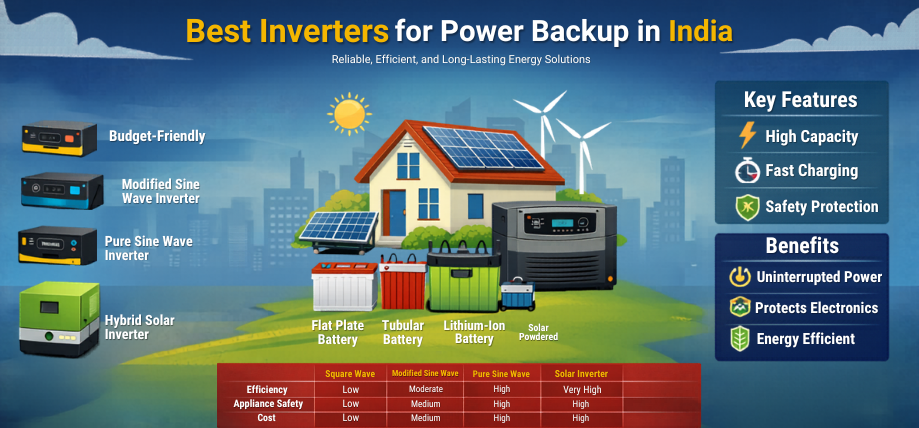
Power interruptions remain a persistent challenge across many regions, making a high-performance inverter for power backup an essential investment for modern households and businesses. Whether we are safeguarding productivity, ensuring uninterrupted comfort, or protecting sensitive electronics, selecting the best inverter in India requires a deep understanding of technology, capacity, battery compatibility, and long-term performance.
This comprehensive guide delivers detailed insights, expert comparisons, and strategic recommendations to help us choose the most efficient, durable, and intelligent inverter systems available today.
Understanding Inverters: The Backbone of Power Backup Systems
An inverter is a device that converts direct current (DC) from batteries into alternating current (AC) to power household appliances during outages. Modern inverters are engineered with advanced circuitry, intelligent load management, and battery optimization technologies to deliver seamless performance.
Types of Inverters for Home and Office Use
1. Square Wave Inverters – Budget-Friendly Basics
Square wave inverters are the simplest type, suitable for basic appliances.
Key characteristics:
- Affordable pricing
- Suitable for lights and fans
- Limited compatibility with sensitive devices
2. Modified Sine Wave Inverters – Balanced Performance
These offer improved efficiency compared to square wave models.
Advantages:
- Moderate pricing
- Compatible with most appliances
- Better efficiency
3. Pure Sine Wave Inverters – Premium Performance
The most advanced and recommended type for modern homes.
Key benefits:
- Smooth power output
- Safe for sensitive electronics
- High efficiency and reliability
Top Features to Consider When Choosing the Best Inverter
Power Capacity (VA Rating)
The inverter capacity determines how many appliances it can support.
- Small homes: 600–900 VA
- Medium homes: 1000–1500 VA
- Large homes: 1500–3000 VA
Battery Compatibility
Inverters are paired with batteries for backup storage.
- Flat Plate Batteries: Budget-friendly
- Tubular Batteries: Long-lasting and efficient
- Lithium-ion Batteries: Advanced and maintenance-free
Backup Time
Backup duration depends on battery capacity and load.
Charging Speed
Fast charging ensures quick recovery during frequent outages.
Safety Features
Modern inverters include:
- Overload protection
- Short circuit protection
- Deep discharge protection
Display and Smart Features
- LCD/LED indicators
- Mobile app integration
- Real-time performance monitoring
Best Inverters for Power Backup in India (Detailed Analysis)
1. High-Efficiency Pure Sine Wave Inverter
Designed for maximum reliability and appliance safety, this category is ideal for modern households.
Highlights:
- Stable voltage output
- Silent operation
- High energy efficiency
2. Smart Inverter with Digital Display
Perfect for tech-savvy users.
Key features:
- Intelligent battery management
- Digital monitoring system
- Enhanced performance tracking
3. Heavy-Duty Inverter for Large Homes
Suitable for running multiple appliances simultaneously.
Advantages:
- High load capacity
- Durable construction
- Extended backup support
4. Compact Inverter for Small Apartments
Ideal for limited space environments.
Benefits:
- Space-saving design
- Easy installation
- Efficient performance
5. Hybrid Solar Inverter
Combines inverter functionality with solar power support.
Key strengths:
- Reduced electricity bills
- Eco-friendly operation
- Dual charging capability
Comparison Table: Choosing the Right Inverter
| Feature | Square Wave | Modified Sine Wave | Pure Sine Wave | Solar Inverter |
|---|---|---|---|---|
| Efficiency | Low | Moderate | High | Very High |
| Appliance Safety | Low | Medium | High | High |
| Price | Low | Medium | High | High |
| Noise Level | High | Medium | Low | Low |
| Best Use Case | Basic | Moderate Use | Home/Office | Energy Saving |
Benefits of Installing a High-Quality Inverter
1. Uninterrupted Power Supply
Ensures continuous operation of essential appliances.
2. Protection for Electronics
Prevents damage caused by voltage fluctuations.
3. Energy Efficiency
Modern systems optimize power consumption.
4. Long-Term Cost Savings
Reduces dependency on generators.
Load Calculation: Determining the Right Inverter Size
To choose the correct inverter:
- List all appliances
- Calculate total wattage
- Add buffer capacity (20–25%)
- Select appropriate VA rating
Best Battery Options for Inverters
Flat Plate Batteries
- Lower cost
- Shorter lifespan
Tubular Batteries
- Longer life
- Better performance
Lithium-Ion Batteries
- Lightweight
- Fast charging
- Maintenance-free
Installation Tips for Maximum Efficiency
- Place inverter in a ventilated area
- Avoid direct sunlight
- Use high-quality wiring
- Ensure proper earthing
Maintenance Tips for Long-Lasting Performance
- Check battery water levels regularly
- Clean terminals to prevent corrosion
- Avoid overloading
- Schedule periodic servicing
Common Mistakes to Avoid When Buying an Inverter
- Choosing incorrect capacity
- Ignoring battery compatibility
- Overlooking safety features
- Buying low-quality products
Inverter vs Generator: Which is Better?
| Feature | Inverter | Generator |
|---|---|---|
| Noise | Silent | Noisy |
| Maintenance | Low | High |
| Fuel Required | No | Yes |
| Eco-Friendly | Yes | No |
| Cost Efficiency | High | Moderate |
Future Trends in Inverter Technology
- AI-powered energy management
- Smart home integration
- Solar hybrid systems
- Lithium battery dominance
Conclusion: Power Your Home with Confidence
A reliable inverter is more than just a backup device—it is a critical component of modern living. By selecting a system that aligns with our energy needs, budget, and usage patterns, we ensure consistent power, enhanced safety, and long-term efficiency.
FAQs
1. Which inverter is best for home use?
Pure sine wave inverters are the best choice.
2. What is VA rating?
It indicates the inverter’s power capacity.
3. How long does an inverter battery last?
Typically 3–5 years.
4. Can an inverter run an AC?
Yes, with high-capacity models.
5. Which battery is best?
Tubular batteries are widely preferred.
6. How to calculate inverter capacity?
Add total load and include buffer.
7. Are inverters safe?
Yes, with built-in protections.
8. Do inverters make noise?
Pure sine wave models are silent.
9. What is backup time?
Duration the inverter can supply power.
10. Can I use inverter for office?
Yes, for uninterrupted work.
11. Are solar inverters worth it?
Yes, for energy savings.
12. How often should batteries be maintained?
Monthly checks are recommended.
13. What is deep discharge protection?
Prevents battery damage.
14. Can inverter run refrigerator?
Yes, with sufficient capacity.
15. What is charging time?
Usually 6–10 hours.
16. Are lithium batteries better?
Yes, but more expensive.
17. Can inverter power TV and Wi-Fi?
Yes, easily.
18. What happens during overload?
The inverter shuts down for safety.
19. How to increase backup time?
Use higher capacity batteries.
20. Are inverters eco-friendly?
Yes, especially solar models.
21. Can inverter be used in shops?
Yes, for business continuity.
22. Do inverters consume electricity?
Minimal consumption for charging.
23. What is hybrid inverter?
Supports both grid and solar power.
24. Can inverter damage appliances?
No, pure sine wave ensures safety.
25. How long do inverters last?
Typically 8–10 years.